TL;DR
The Shift: Why Your Traditional Holiday Playbook is Obsolete
The 2026 holiday season represents a structural shift in e-commerce. With AI-referred retail traffic surging 693% year-over-year, millions of shoppers are now bypassing traditional search engines, delegating their research and product discovery to AI assistants. To remain competitive, brands must transition from AI-assisted marketing to goal-based ‘Agentic Marketing.’ This involves deploying a collaborative team of specialized AI agents, such as those for insight generation, audience segmentation, and content creation, to optimize strategy in real-time autonomously. Success in Q4 depends on moving from ‘campaign operators’ to ‘strategic architects,’ focusing on outcome-based metrics rather than just hours saved.
Most conversations about holiday marketing revolve around consumer confidence, inflation, or shifting ad costs. Those challenges are real, but they aren’t the biggest threat to your Q4 revenue in 2026. The real issue is operational: the traditional holiday playbook of manual campaign building, static audience segmentation, and retrospective data analysis is officially broken.
The sheer volume, speed, and complexity of modern peak-season e-commerce have outpaced what a traditional marketing team can execute manually. To remain competitive this holiday season, the fundamental architecture of how your team works must change. We are seeing a massive structural shift from software-assisted marketing to Agentic Marketing.
Instead of buying more software platforms and forcing your team to pull levers manually, leading brands are effectively “hiring” collaborative teams of specialized, autonomous AI agents. These aren’t simple chatbots; they are dedicated digital workers designed to handle specific operational domains, from generating infinite multichannel copy and resolving complex customer identities in real time, to analyzing revenue drivers before the season ends.
For the modern brand, this changes the entire game. Your success this Q4 isn’t just about how steep your Black Friday discounts are. It depends entirely on whether you can upgrade your team from exhausted campaign operators into strategic architects, letting AI agents do the heavy lifting of execution.
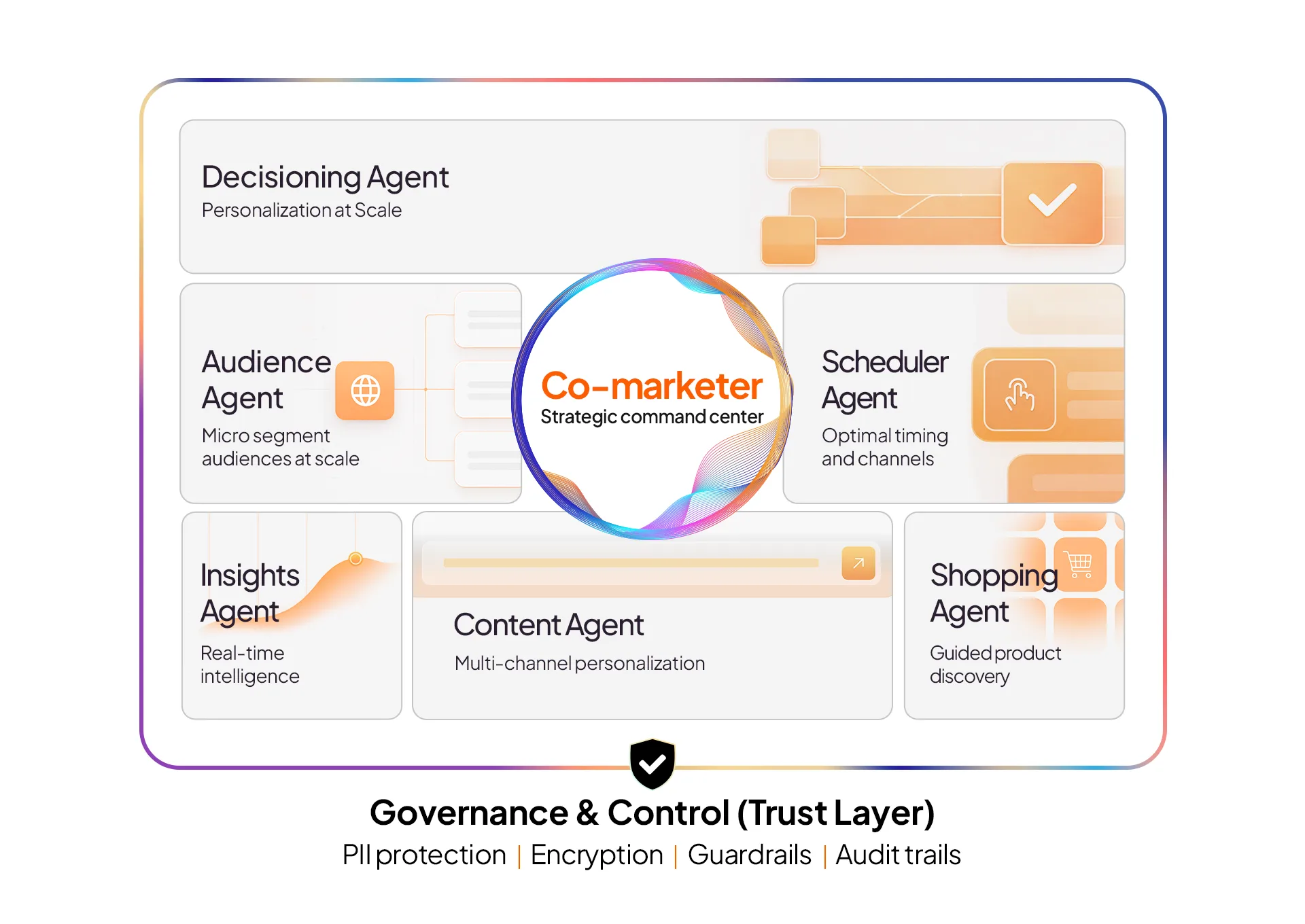
Leverage the power of the above agents by talking to us today!
Here is the exact playbook for building a marketing team that never sleeps.
The Agentic Playbook: Building a Team That Never Sleeps
To win this season, you need to transition from manual campaign operators to agentic orchestrators. You aren’t just buying software; you are effectively hiring a team of tireless, specialist AI agents that collaborate to execute your strategy. But before you start building AI agents, you need a strong data foundation that ensures identity resolution and governance.
If your customer data lives in disconnected silos, even the most advanced agent will misfire, resulting in disjointed messaging and wasted ad spend. Before deploying creative or optimization agents, you must establish a foundational agent that acts as the connective tissue of your marketing stack. This agent continuously cleans, unifies, and stitches together behavioral signals from your website, mobile app, and physical stores into a single, real-time identity graph.
This infrastructure must be integrated and fully operational prior to the holiday rush. The real-time payoff happens on high-traffic days like Black Friday and Cyber Monday: it allows your stack to instantly recognize a loyal, high-value customer who happens to be shopping on a new device or browsing incognito for gifts. By resolving their identity in milliseconds, you prevent the system from treating them like a cold prospect and mistakenly burning margin on a generic “Welcome” discount.
Now, let’s jump focus to some agentic ideas.
Multichannel Creative Production
During peak season, the sheer volume of content required- emails, SMS, push notifications, just the general versions is enough to break a creative team. A Content Agent serves as an infinite creative engine. It takes a single, simple prompt and generates a campaign-ready copy tailored to specific channels, fully constrained by your brand voice and safety guardrails.
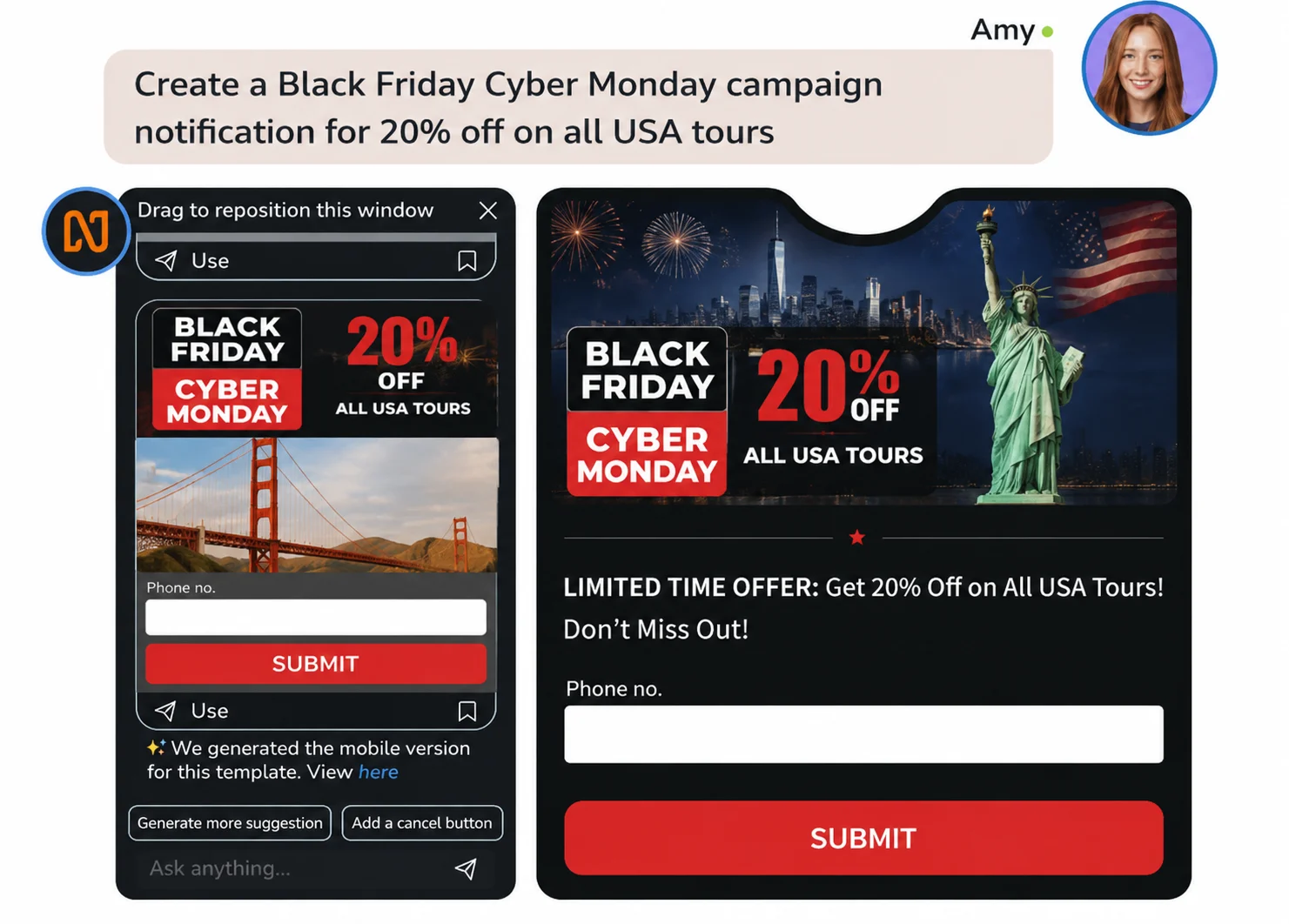
The Holiday Play: Aim this agent directly at your most brutal send windows, and remember that those now begin well before Black Friday: holiday send volumes ramp up from early November and peak through Cyber Monday. By letting the agent do the heavy lifting of drafting, your human team upgrades their role from exhausted copywriters to strategic editors: reviewing, approving, analyzing, and optimizing.
Propensity Targeting, Affinity Scoring, and Continuous Audience Refreshing
Humans are bad at finding non-obvious patterns in massive datasets. AI is perfect at it. Leverage agents that continuously build and refine hundreds of micro-audiences from whatever signals and intent you are already tracking. They can do this job faster and deeper than any human, and your team can then analyze the output and fine-tune it to what the business needs. You tell the agent your objective (e.g., “Drive sales in the winter wear category among shoppers who have shown interest in it”), and it mathematically clusters shoppers into hyper-targeted personas.
The Holiday Play: Build your agents to self-optimize audiences against the goals you set for each campaign and category. BFCM is never a single campaign: a large retailer runs separate pushes for electronics, apparel, and furniture, so the cohorts behind each should refresh dynamically through peak season. Holiday shopping intent is notoriously fickle; an audience that looked highly engaged on Wednesday might be totally stale by Saturday.
Send-Time Optimization, Precise Message Pacing, and Determining the Next-Best-Action per User.
While traditional batch-and-blast campaigns are still a standard way to broadcast major promotions, relying on them too heavily during peak season is a fast track to list fatigue, spam folders, and mass unsubscribes. Instead, you can leverage an agent that acts as a digital traffic controller. It learns when and where individual shoppers prefer to be contacted, hopping seamlessly between email, app, and SMS, and paces the delivery of your messaging to maximize engagement without burning out your audience.
The Holiday Play: Break free from the rigid “Black Friday at 6 AM” blast. During Cyber Week, while your competitors are overwhelming inboxes with three generic emails a day, let your agent orchestrate the highest-stakes moments. For example, if a shopper abandons a high-value cart, the agent dynamically decides the next best action: instead of forcing an automated email four hours later, it holds the message until 7 PM and sends a correspondence.
At its core, this is decisioning: determining the next best action for every user, which message, on which channel, at which moment, instead of pushing everyone down the same fixed journey.
Guided Discovery with Shopping Agents
The holidays bring a tidal wave of new shoppers who often don’t know exactly what they want. A Shopping Agent deployed on the website makes the first purchase effortless. It guides product discovery in a chat interface – where you can embed cross-sell and upsell algorithms to maximize AOV.
The Holiday Play: Deploy the agent on your highest-traffic landing and category pages before peak season. Guided discovery turns vague gift-buying intent (“something for my dad under $50”) into a confident shortlist, while embedded cross-sell prompts lift AOV on every conversation.
Pattern Detection, Revenue Driver Analysis, and Generating Prescriptive Actions.
Waiting until January to do a holiday post-mortem means you are analyzing money you already lost. Utilize an Insights Agent that monitors revenue drivers in real-time, surfacing the “why” behind performance anomalies in a short amount of time, rather than the days it takes a human analyst.
The Holiday Play: Establish a clear data baseline (with and without AI active) before the rush begins. You want empirical proof of the revenue lift your agents generated when it comes time to defend your Q1 marketing budget.
The Payoff & Investment: Cutting Through the Hype
When implemented correctly, the financial and operational payoff of agentic marketing is staggering. Brands are turning six-hour copywriting marathons into 30-second tasks. They are spinning up campaigns 25x faster, building audience segments 50x deeper, and seeing a 60% boost in interaction rates by replacing endless catalog scrolling with AI-guided discovery.
But here is the catch: you have to build your stack properly.
- Unify Your Data First: Stop buying new tools if your data is a mess. Your first investment must be connective tissue. Combine web, app, email, POS, and loyalty data into one unified stream. Clean data is the ultimate multiplier for agentic efficiency.
- Beware of “Agent-Washing”: Over 40% of enterprise AI projects will be canceled by 2027 because of fuzzy value and runaway costs. Do not buy a legacy platform that just slapped an “AI” sticker on its dashboard. Evaluate vendors by demanding outcome-based economics and interoperable, MCP-native systems.
- Deploy an AI Trust Layer: You must govern these agents. An AI Trust Layer ensures every automated action complies with PII protections, encryption standards, and your specific brand tone. It keeps the machines executing the heavy lifting while reserving sensitive, high-trust moments for human approval.
If you optimize merely for “hours saved,” you will fall into a competency trap. Track actual business outcomes, revenue per visit, conversion rates, and margin. Teams that focus on impact are twice as likely to see true ROI from their AI initiatives.
Conclusion & Your Agentic Action Plan
The old division of labor, spending 80% of your time building campaigns and 20% analyzing them, is dead. Agents flip the ratio, allowing your team to spend 80% of their time on high-level strategy and creativity. The brands that dominate this holiday season won’t necessarily have the largest ad budgets; they will be the ones that successfully pair agentic execution with strict outcome discipline.
Here is your actionable checklist to hit the ground running:
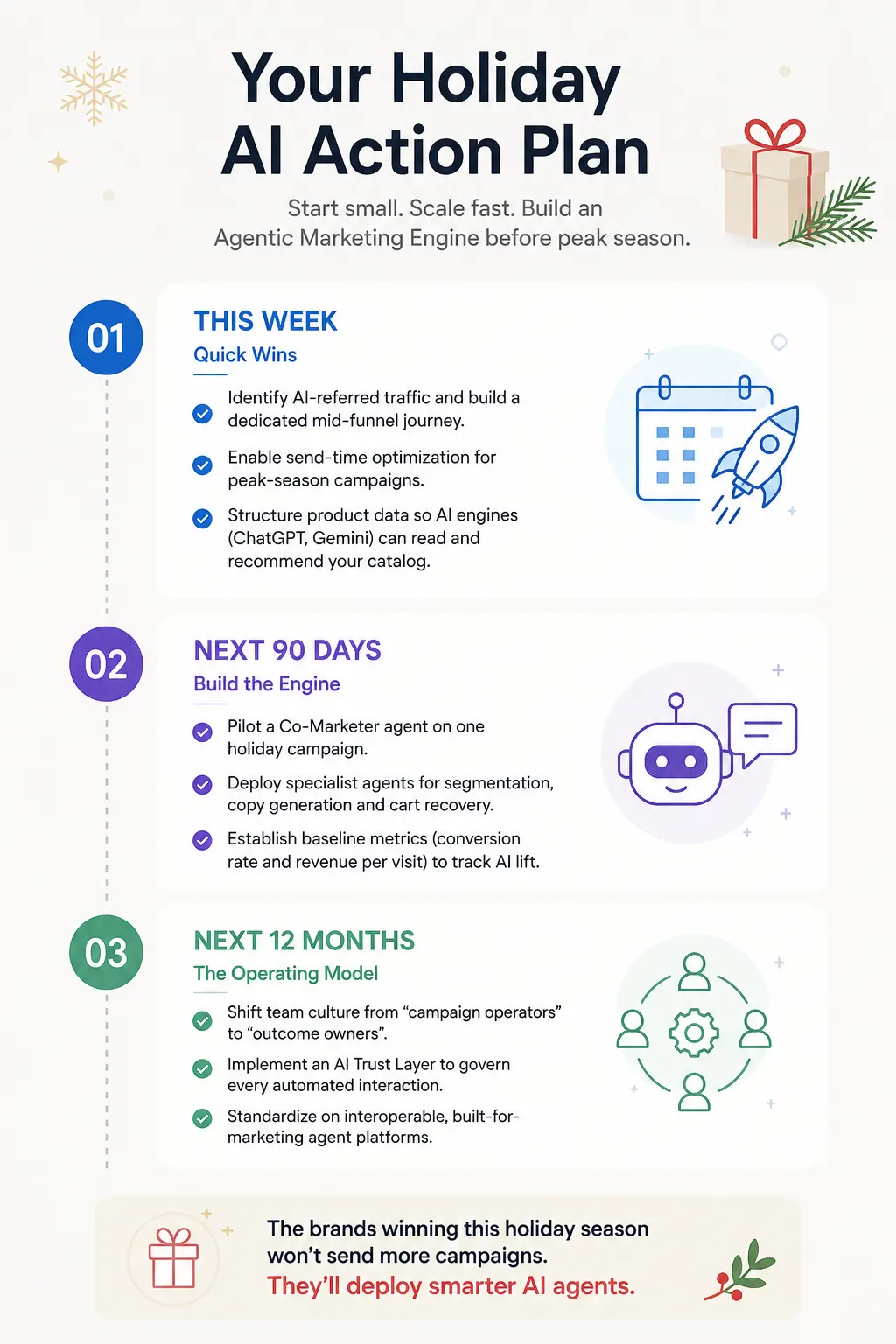
The shift is here. Start narrow, measure relentlessly for impact, and expand your team of agents as they prove their worth.
Talk to us today!
Or read our migration playbook built for the BFCM season